
The California Supreme Court has scheduled oral arguments in Family Violence Appellate Project et al. v. Superior Court of Contra Costa County et al., for June 3.
For the Coalition to Capture the Record and for advocates who’ve been calling for practical policy solutions to the growing court reporter shortage, this is a moment years in the making.
The Court has framed the case’s central question plainly: Does the prohibition on electronic recording of certain proceedings violate the California Constitution when an official court reporter is unavailable and a litigant cannot afford to pay a private court reporter?
That question sounds narrow. Its implications are anything but.
How We Got Here
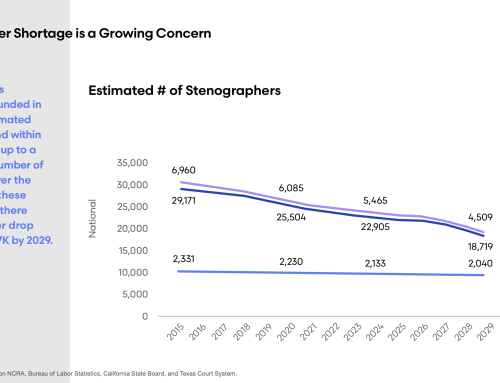
As we have reported previously, California is struggling with a growing shortage of stenographers that threatens the timely and accurate capture of the record — the bedrock of judicial integrity.
The numbers tell a stark and urgent story. As of 2026, California’s trial courts employed 1,101 court reporters — still 458 short of what is needed to provide verbatim coverage of the current caseload, according to the Judicial Branch of California. Between January 2023 and June 2025, courts hired 286.2 full-time equivalent reporters and lost 273.3, yielding a net gain of just 12.9 FTE across the entire state.

Photo Credit: Judicial Council of California, 2026
The consequences for litigants are direct and measurable: from April through June 2025, 74 percent of hearings in civil, family, and probate cases proceeded with no verbatim record at all. For the litigants in those courtrooms, the absence of a record is not a procedural footnote. It is a barrier to appeal, a denial of any meaningful access to justice and a violation of litigants’ due process rights.
In response, circuit courts have issued orders authorizing unmanned electronic recording for certain civil proceedings when a stenographer is unavailable. Los Angeles acted first, in September 2024. Santa Clara followed in mid-November, citing a drastic reduction in its stenographic workforce. These orders acknowledge the dire circumstances — but as we have written before, they are stopgap measures. They do not resolve the underlying statutory restrictions, and they do not reach the litigants who need protection most.
The Human Cost
The shortage of stenographers is not an administrative inconvenience. It is a justice problem.
When no official court reporter is available, litigants who can afford to hire a private stenographer out of pocket can still ensure access to the record. Those who cannot — and in family law, probate, and domestic violence proceedings, that is often the majority — leave the courtroom with limited options.
As Jennafer Wagner, Family Violence Appellate Project’s Director of Programs, has explained: “Thousands of litigants in family law and probate cases leave courtrooms every day without a verbatim record of what transpired. The result is often devastating for low-income litigants, including survivors of domestic violence who rely on courts for critical orders to protect them and their families, including restraining orders, child custody and visitation orders, spousal and child support orders, orders declaring debt was caused by domestic abuse, and many others.”
When those litigants cannot get a record, they often cannot appeal. When they cannot appeal, the courthouse door closes on them — quietly, without fanfare, and without any official acknowledgment that something has gone wrong. For those litigants, the gap between statute and reality is not an abstraction. It is the difference between having a legal remedy and having none.
When litigants cannot get a record, they often cannot appeal. When they cannot appeal, the courthouse door closes on them — quietly, without fanfare, and without any official acknowledgment that something has gone wrong. For those litigants, the gap between statute and reality is not an abstraction. It is the difference between having a legal remedy and having none.
Why This Case Matters
The petitioners in Family Violence Appellate Project are not asking the Court to eliminate the court reporter profession or to prefer one recording method over another. They are asking the Court to recognize that when a litigant has no access to an official reporter and cannot pay for a private one, a blanket prohibition on electronic recording raises serious constitutional concerns — concerns rooted in due process, equal protection, and the fundamental right of access to the courts.
The framing of the issue by the Supreme Court itself signals that these concerns have traction. The Court issued an order to show cause, meaning it has already determined that the petition presents a question substantial enough to warrant full merits briefing and oral argument. The Court receives far more petitions than it accepts for full review. The fact that this case cleared that bar matters.
For the Coalition, the constitutional question is inseparable from the practical one. We have long argued that digital and voice reporting by trained, certified professionals is not a lesser substitute for stenography but a legitimate and proven method of creating the verbatim record that justice requires. Digital reporters use purpose-built hardware and software to capture high-quality audio, provide real-time text translation, and maintain detailed annotations. They perform meticulous testing before and during proceedings. They bring the same essential human oversight that protects record integrity: administering oaths, managing exhibits, intervening to ensure clear speech, preventing overlapping dialogue, documenting nonverbal responses, and bearing professional responsibility for accuracy and completeness.
Unmanned recording systems, while a laudable pivot from unsuccessful recruiting efforts, do not go far enough.
The answer to the shortage is not to leave a microphone running in an empty room. It is to expand the pool of certified professionals empowered to capture the record using all available methodologies. California’s resistance to formally recognizing digital reporting has not protected the quality of the record; it has simply left more and more proceedings with no record at all.
A ruling from the Supreme Court that section 69957(a) cannot constitutionally be applied to bar all electronic recording when no reporter is available would not end the larger debate about how California courts should be staffed. But it would establish something critically important: that litigants have a constitutional floor, and that a complete record is not a luxury reserved for those who can afford it.
What Comes Next
This case is a critical step toward ensuring access for all. It asks California’s highest court to affirm that the Constitution will not permit the shortage to become a mechanism for denying access to justice to those who can least afford to lose it.
The record belongs to every litigant — not just the ones who can pay for it. On June 3, California’s Supreme Court will begin deciding whether the Constitution agrees.
Leave a Reply